 Dogyoga
The benefits of puppy yoga: 9 real benefits for you and your dog
Less stress, a calmer dog and a closer bond: the real benefits of puppy yoga and doga, what the research on dogs and people suggests, and how to get them at home.
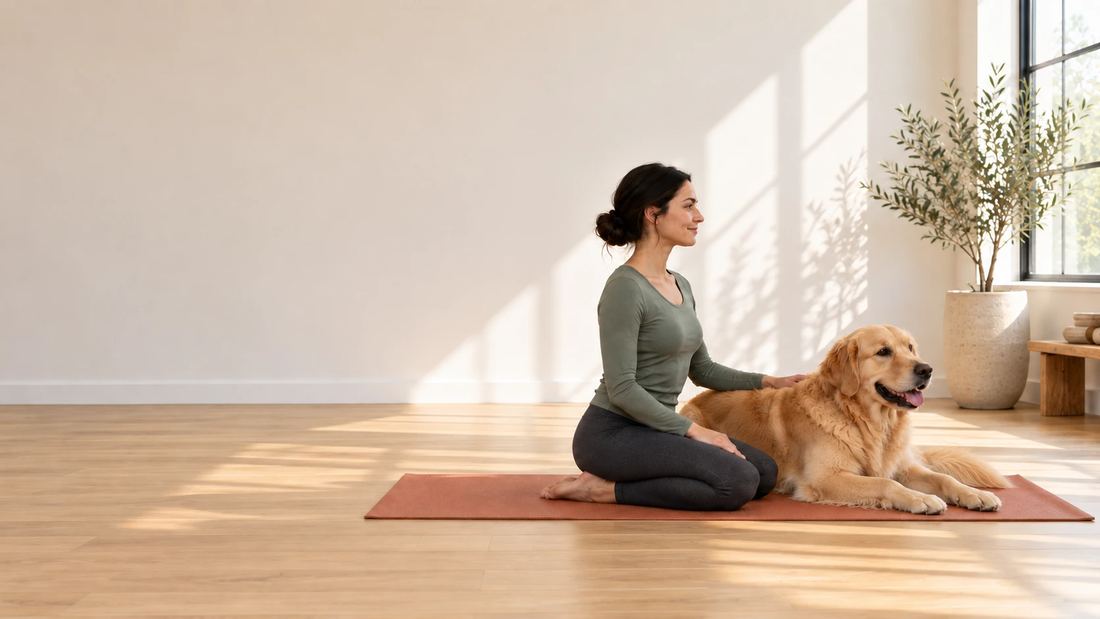
The benefits of puppy yoga are easy to feel and a little harder to name. You come off the mat calmer, your dog is relaxed and somehow you feel closer to each other. Whether you join a class with a room full of puppies or practise doga at home with your own dog, the benefits come from the same simple mix: slow breathing, gentle movement and calm time spent touching an animal you love. Here are nine real benefits of puppy yoga, what is behind them, and how to get the most out of each one.
What puppy yoga is (in one minute)
Puppy yoga is a gentle yoga session with dogs on or around the mat. In a class, puppies wander between the participants while a teacher leads easy poses. At home, it is yoga with your own dog, often called doga or dog yoga: you breathe and stretch, and your dog joins in the way dogs do, lying against you, sniffing your hands or walking under your downward dog. If you are new to it, start with our guide to what puppy yoga is, then come back here.
1. Less stress, often within minutes
Most people notice this first. Slow breathing tells the body it is safe, and gentle contact with a dog adds to the effect. A study with university students found that spending ten minutes petting dogs and cats was linked with lower levels of cortisol, the stress hormone. You don't need a lab to feel it: ten minutes of slow breaths with a warm dog against your leg changes the mood of an evening.
2. A calmer dog
Dogs read our bodies all day long. When your movements slow down and your breathing deepens, many dogs settle too. Done regularly, the mat itself becomes a signal: this is where we rest together. That is why a calm routine on the mat helps restless or nervous dogs, and why we wrote a separate guide on breathing exercises for an anxious dog.
3. A closer bond with your dog
Puppy yoga is quality time without a goal. You are not training, walking to a schedule or asking for anything: you are just together. Research on dogs and their owners has found that friendly eye contact between them can raise oxytocin, the "bonding hormone", in both species. Quiet, shared moments on the mat are exactly that kind of contact, and many owners say their dog seeks them out more after a few weeks of doga.
4. Gentle movement you will actually keep doing
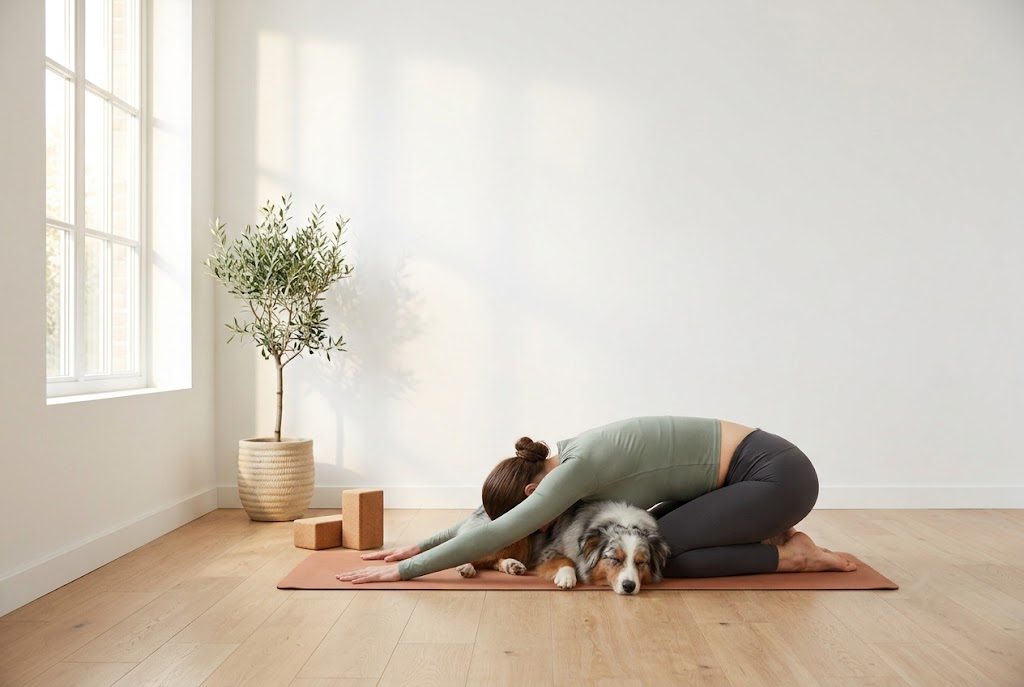
The poses in dog yoga are simple: cat-cow, child's pose, puppy pose, a low lunge, a supported bridge. They loosen the hips, the back and the shoulders without asking for flexibility or fitness. Because your dog makes it fun, it is far easier to keep a habit than with a workout you dread. Five minutes most days does more than one long session a month.

5. A mood lift and a lot of laughter
There is something deeply funny about holding a serious pose while a dog licks your ear or steals the spot you were about to lie on. Laughter is part of the practice. It lowers the pressure to do things "right" and makes the session something you look forward to rather than a chore.
6. Better sleep, for both of you
An evening session of slow breathing, soft stretches and a long final rest is a natural wind-down. It moves you away from screens and tells your body the day is over. Dogs love routine, and many start to settle earlier once the evening doga ritual becomes part of their day.
7. Mindfulness without the effort
Meditation can feel hard when your mind is busy. A dog makes it easier: their breathing, the warmth of their fur and the small sounds they make give you something real to focus on. You end up being present without trying. That is mindfulness in its simplest form.
8. Gentle enrichment for your dog
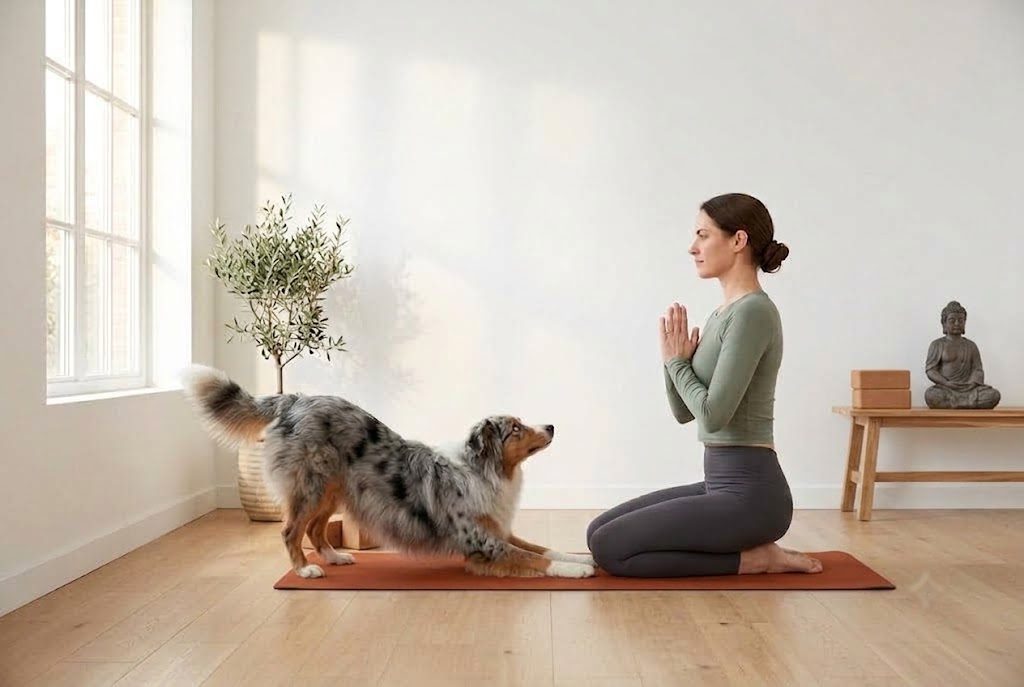
For your dog, doga is new smells, new positions, small treats and your full attention. Easy moves such as a shared play bow, a short stay beside your warrior pose or a slow walk under your bridge give their brain something to do. Calm enrichment like this is especially welcome for dogs that can't run far, which is why doga works well as yoga for senior dogs.
9. It's free, at home, every day
A puppy yoga class is a lovely treat, but it is a one-off outing that usually costs $30 to $60. Most of its benefits come from regular practice, and that is easiest at home with your own dog. All you need is a mat and a quiet corner. Our guide to puppy yoga at home walks you through your first session.
How to get the most from puppy yoga
- Keep it short and regular. Five to fifteen minutes, three to five times a week, beats one long session.
- Let your dog choose. Never hold your dog in a pose. Invite, reward with a treat or a stroke, and let them leave the mat whenever they like.
- Pick a calm moment. After a walk and a toilet break works best. A dog full of energy won't settle.
- End with a long rest. Savasana side by side is the part most dogs love most, and many fall asleep.
- Stay safe. Skip poses that put weight on your dog, and ask your vet first if your dog is young, old, injured or has joint problems.

Frequently asked questions
What are the main benefits of puppy yoga?
Less stress, a calmer dog, a closer bond, gentle movement and better sleep. Most people also find it simply joyful. The benefits grow with regular practice.
Is puppy yoga good for anxiety?
Slow breathing and calm contact with a dog can help you relax, and a regular quiet routine helps many restless dogs settle. It is not a treatment, though: if you or your dog struggle with anxiety, talk to a doctor or a vet as well.
Does my dog benefit from doga too?
Yes. Your dog gets your full attention, calm enrichment, gentle movement and a predictable routine. Let your dog take part in their own way: lying close is enough.
How often should I do puppy yoga to feel the benefits?
Three to five short sessions a week is a good rhythm. Many people feel calmer after the very first session, and the bond with their dog grows over a few weeks.
Can I get the benefits of puppy yoga without a class?
Yes. Practising doga at home with your own dog gives you the same calm, more often and for free. The Dogyoga app builds a new guided session around your dog every day.
Sources
- Pendry, P. and Vandagriff, J. L. (2019). Animal Visitation Program (AVP) Reduces Cortisol Levels of University Students. AERA Open. A randomized trial: ten minutes of petting dogs and cats lowered students' cortisol, the stress hormone.
- Nagasawa, M. et al. (2015). Oxytocin-gaze positive loop and the coevolution of human-dog bonds. Science 348, 333-336. Mutual gazing between dogs and their owners raised oxytocin in both.
- Zaccaro, A. et al. (2018). How Breath-Control Can Change Your Life: A Systematic Review on Psycho-Physiological Correlates of Slow Breathing. Frontiers in Human Neuroscience. Slow breathing was linked with more relaxation and less anxiety and arousal.